

The Compliance Passport for Tokenised Finance
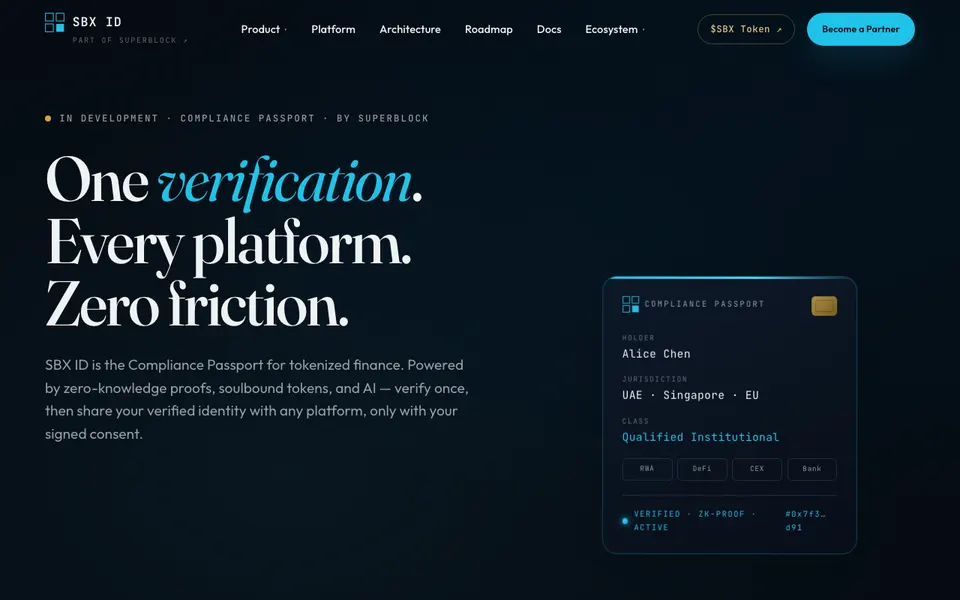
SBX ID lets a person verify once, then share that verified identity with any integrated platform, only with their signed consent. Platforms receive exactly what they ask for and still run their own AML, in minutes instead of days.
Consent-based, privacy-first compliance. A soulbound token shows a wallet is verified without carrying personal data; documents stay encrypted off-chain and are released only when the user signs. In development.

Standards and networks
What SBX ID delivers
Verify once, use everywhere
One KYC and one credential, recognised by every integrated platform, so an investor does not repeat document uploads and checks for each product or network they use.
Consent, not copies
Personal documents stay encrypted off-chain, and a platform receives only the fields it asks for, when the user signs. For eligibility checks, a zero-knowledge proof can confirm a condition without revealing anything else.
Platforms stay responsible
Relying platforms verify the credential, run their own AML screening and keep their regulatory obligations, so SBX ID accelerates due diligence rather than pretending to replace it.
How it works
A person completes KYC once and SBX ID issues a verifiable credential into their wallet, anchored by a soulbound token that carries no personal data. When a platform needs to know more, it sends a request; the user reviews and signs, and only the requested information is shared. Where a simple yes or no is enough, a zero-knowledge proof confirms eligibility without disclosure. Credentials are re-screened, renewed and revoked by a jurisdiction-aware rules engine.
A credential is issued once, then shared on consent or proven by zero-knowledge proof across tokenisation, settlement and trading in the ecosystem.
1/3 · Verify once. The user completes KYC once. SBX ID issues a verifiable credential into their wallet, anchored by a soulbound token.
Built for everyone in the compliance chain
Platforms, custodians and users each get something different from one verified identity. Choose one to follow their journey.
Step 1 of 3: Request. Ask for the specific fields, or the proof, your onboarding needs.
Onboard verified users in minutes
Receive verified identity data on the user's consent, run your own AML on it, and keep your regulatory responsibility.
The challenge
Every platform re-runs KYC for users who have already been verified elsewhere, adding cost, drop-off and yet more copies of sensitive data.
What changes
- Verified identity on consent, instead of a fresh KYC
- You keep AML responsibility, with better data and less friction
- Jurisdiction-aware rules that update as regulations change
Eligibility with cryptographic assurance
Confirm a counterparty is eligible without exchanging, storing or protecting their documents.
Confirming a counterparty's eligibility usually means exchanging documents that then have to be stored, secured and eventually deleted.
- Check the token: A soulbound token shows the wallet is verified, with no personal data on-chain.
- Request a proof: A zero-knowledge proof confirms eligibility without revealing identity.
- Proceed: Settle with an eligible counterparty, with an audit trail of the check.
- Cryptographic assurance of counterparty eligibility
- No sensitive documents exchanged or stored
- Chain-agnostic across permissioned and public networks
Verify once, stay in control
Verify once, then decide which platform sees what and when, from a credential held in your own wallet.
Every new platform asks for the same passport, selfie and proof of address, and keeps its own copy of them.
- Verify once: Complete KYC once with SBX ID.
- Hold your credential: The credential lives in your wallet; documents stay encrypted off-chain.
- Approve requests: See who is asking for what, and share only when you sign.
- Share only what a platform asks for, and only when you sign
- Prove eligibility with zero-knowledge proofs where that is enough
- One credential across every integrated platform
What's inside
The capabilities that make up SBX ID. Select one to see how it works.
Verify once
A person completes KYC once with SBX ID, including document checks, liveness and sanctions screening. SBX ID issues a verifiable credential into their wallet, and a non-transferable soulbound token shows any platform that the wallet is verified without carrying personal data.
- One onboarding instead of a new KYC for every platform
- Soulbound token as the on-chain marker, with no personal data on-chain
- Documents encrypted off-chain; the user holds the keys
Consent-based sharing
When a platform needs identity data, it sends a request. The user reviews it and signs, and only the requested fields are released, encrypted to that platform. A consent receipt records who asked for what, when and why.
- Selective disclosure: a platform sees only the fields it requested
- Nothing is released without the user's signature
- Consent receipts give both sides an audit trail
Zero-knowledge eligibility
For many checks a platform does not need identity data at all, just an answer. A zero-knowledge proof can confirm that a wallet belongs to an eligible investor in the right jurisdiction without revealing who they are, or even that they hold an SBX ID.
- Eligibility, investor class and jurisdiction proven without disclosure
- Works with ERC-3643 permissioned tokens across chains
- Protection against duplicate identities without exposing personal data
Platforms stay in control
SBX ID accelerates a platform's customer due diligence rather than replacing it. Platforms verify the credential, run their own AML screening and keep their obligations, while a jurisdiction-aware rules engine keeps credentials fresh through re-screening, renewal and revocation.
- Relying platforms run their own AML on verified data
- Continuous re-screening, expiry and revocation
- Built to regulator standards and designed to be sandbox-ready